
As future 6G networks become increasingly cloud-native, managing computing resources efficiently will be just as important as managing the networks themselves. Cloud-Native Network Functions (CNFs) continuously compete for computing resources such as CPU, memory and energy, while network demand fluctuates throughout the day. Traditional orchestration platforms typically respond only after workloads have changed, resulting in unnecessary energy consumption, overprovisioning or temporary performance degradation.
To address this challenge, UNITY-6G is developing AI-driven orchestration that can anticipate future resource requirements rather than simply reacting to them.
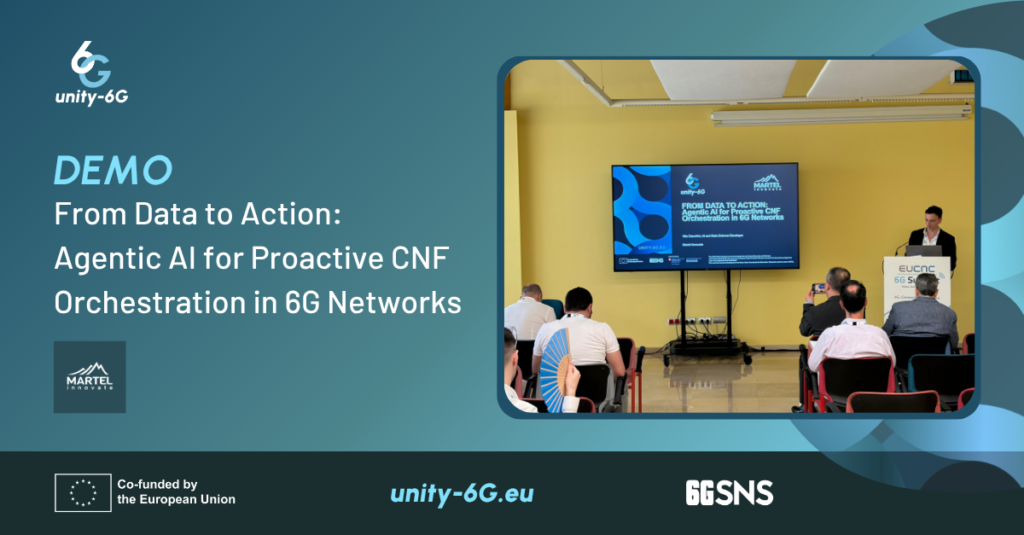
In a new demonstration by Martel Innovate, presented at the EuCNC & 6G Summit 2026, the project showcases how agentic AI can proactively forecast resource demand and support more efficient orchestration of cloud-native network functions.
Moving from reactive to proactive orchestration
The demonstration combines AI-based forecasting with autonomous decision-making to predict future workload patterns before they occur. Instead of scaling network functions only after demand increases, the system forecasts upcoming CPU, memory and energy requirements and pre-allocates computing resources accordingly.
This proactive approach helps reduce unnecessary energy consumption while avoiding delays caused by cold starts when additional resources need to be activated unexpectedly. The result is an orchestration process that is both more responsive and more sustainable.
Agentic AI for intelligent resource management
Rather than relying on a single AI model, the demonstration introduces a multi-agent AI architecture where specialised software agents collaborate to analyse monitoring data, select the most appropriate forecasting model and generate resource allocation recommendations.
Each agent performs a dedicated task—from data analytics and forecasting to orchestration policy generation—while communicating through an open agent-to-agent framework. This modular approach enables orchestration decisions to adapt to changing workloads and operating conditions without depending on rigid rule-based workflows.
By combining specialised forecasting models with AI-assisted reasoning, the system can dynamically choose the most suitable prediction approach for different traffic patterns and infrastructure conditions.
Supporting more sustainable 6G networks
Efficient resource orchestration is becoming increasingly important as 6G infrastructures evolve into highly distributed cloud-edge environments supporting AI applications, industrial automation and mission-critical services.
For network operators, proactive orchestration can lower operational costs by reducing wasted computing resources and improving infrastructure utilisation. For vertical industries deploying private 5G and future 6G networks, it offers a pathway towards more predictable application performance while supporting sustainability objectives through reduced energy consumption.
The demonstration illustrates how AI can move beyond monitoring and analytics to become an active component of network management, enabling future networks to continuously optimise themselves based on predicted demand rather than reacting only after conditions have changed.