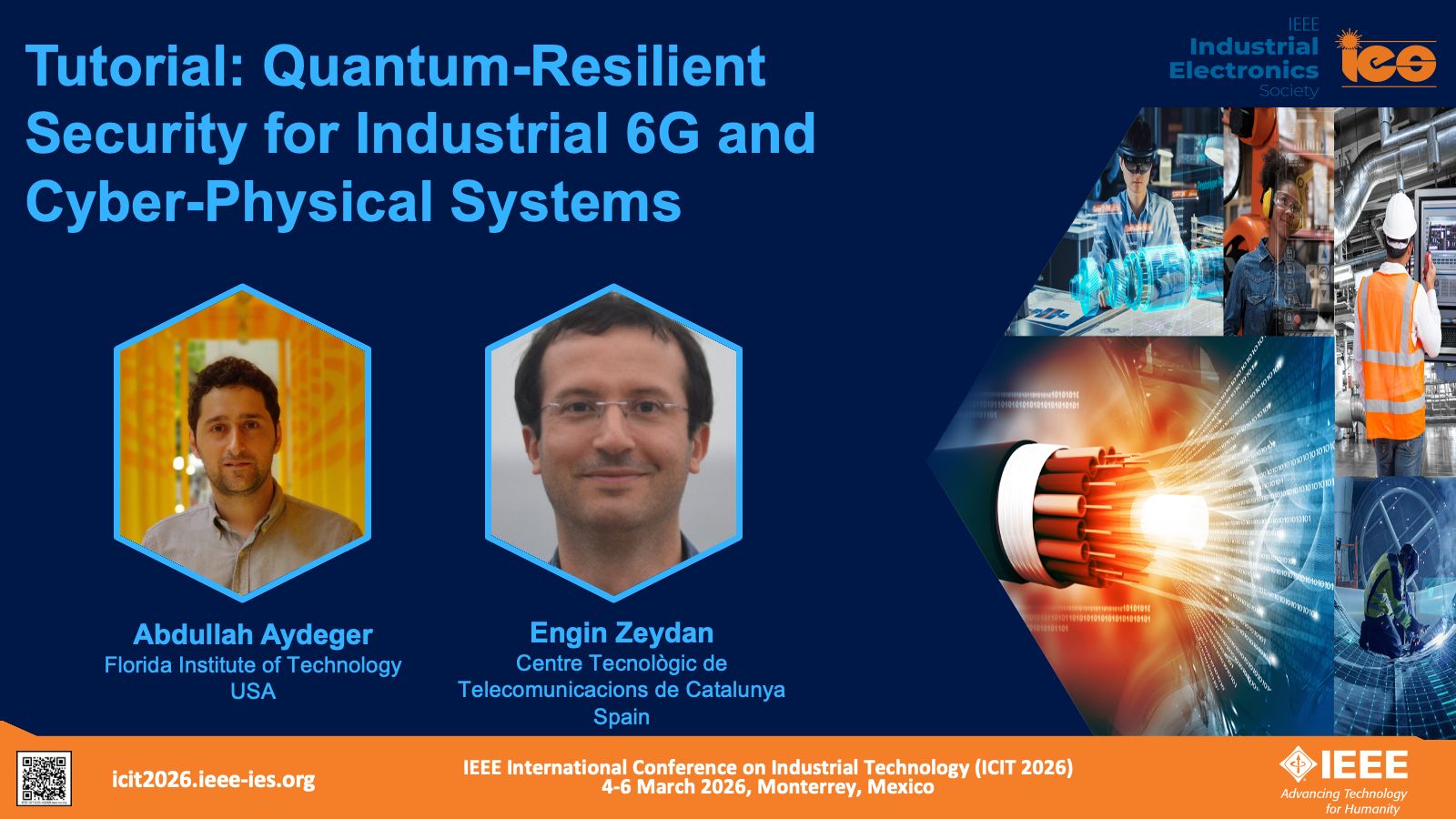
On March 6, 2026, project coordinator Dr. Engin Zeydan (CTTC) delivered a tutorial on “Quantum-Resilient Security for Industrial 6G and Cyber-Physical Systems” at the 27th IEEE International Conference on Industrial Technology (ICIT 2026) in Monterrey, Mexico. The session was co-presented with Prof. Abdullah Aydeger from the Florida Institute of Technology. The tutorial addressed a critical challenge emerging at the intersection of industrial digitalisation, next-generation wireless networks, and cybersecurity: how to secure industrial cyber-physical systems against the long-term risks posed by quantum computing.
Quantum threats to long-lived industrial systems
Industrial cyber-physical systems (CPS) are becoming deeply integrated with advanced wireless connectivity, edge computing, and distributed control platforms. These architectures support applications such as smart manufacturing, robotics, industrial automation, and critical infrastructure monitoring.
The evolution toward 6G-enabled industrial networks will further increase system complexity by introducing ultra-reliable low-latency communication (URLLC), integrated sensing and communication, and large-scale device connectivity across heterogeneous industrial environments.
However, the security of many current communication systems relies on public-key cryptographic algorithms such as RSA and elliptic curve cryptography. These schemes are vulnerable to quantum algorithms such as Shor’s algorithm, which could break widely deployed cryptographic protections once sufficiently powerful quantum computers become available.
Because industrial systems often remain operational for 20–30 years or longer, security mechanisms implemented today must already consider post-quantum security requirements.
Post-quantum cryptography and quantum-safe architectures
The tutorial provided an overview of quantum-resilient security mechanisms applicable to industrial CPS and 6G communication architectures.
Participants were introduced to key concepts including:
- Quantum security threats and their implications for industrial communication protocols
- Post-quantum cryptographic schemes, including lattice-based, code-based, and hash-based cryptography suitable for embedded and industrial devices
- Quantum key distribution (QKD) concepts and potential deployment scenarios in industrial environments
- Architectural integration of quantum-resilient security mechanisms into industrial 6G network architectures
- Performance considerations such as computational overhead, latency impact, and memory requirements on resource-constrained devices
A particular focus of the tutorial was the practical feasibility of post-quantum cryptographic implementations on industrial hardware, where strict constraints on processing power, energy consumption, and memory often apply.
Experimental demonstrations on industrial device platforms
To bridge theory and practice, the tutorial included experimental demonstrations and case studies using current user-equipment platforms that can serve as precursors to future industrial 6G devices.
These demonstrations examined the performance and system-level impact of quantum-resilient security mechanisms, evaluating parameters such as:
- cryptographic processing latency
- communication overhead
- memory footprint
- reliability and system stability in constrained environments
Such experimental evaluations are critical for determining how quantum-safe cryptography can be integrated into real-world industrial communication systems without compromising reliability or real-time performance.
Advancing secure architectures for future 6G systems
Dr. Zeydan’s participation in ICIT 2026 reflects the growing importance of security-by-design approaches in next-generation wireless networks, particularly as industrial systems become increasingly dependent on advanced connectivity.
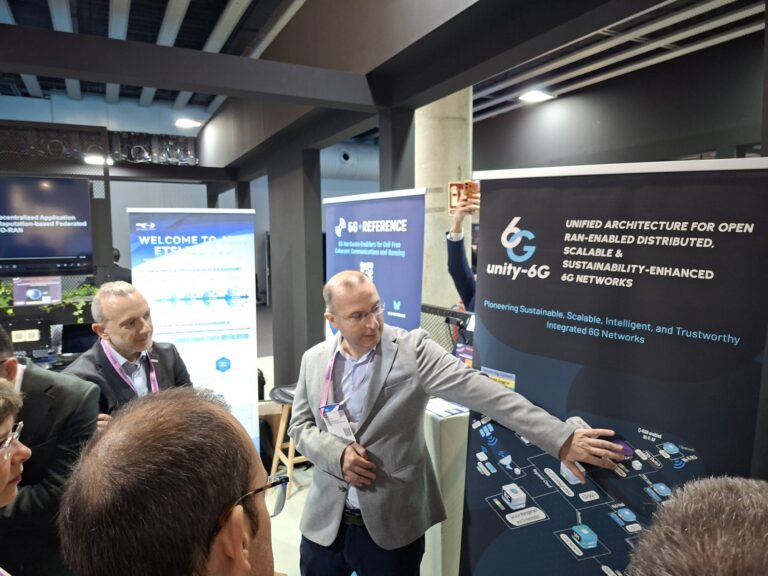
Within UNITY-6G, research activities explore how intelligent, data-driven network architectures can support secure, resilient, and scalable industrial communication systems. Addressing quantum-resilient security for industrial CPS is an important step toward ensuring that future 6G infrastructures remain trustworthy and robust in the long term.
By contributing to discussions at international venues such as ICIT, UNITY-6G continues to engage with the global research community to advance secure communication technologies for the industrial networks of the future.