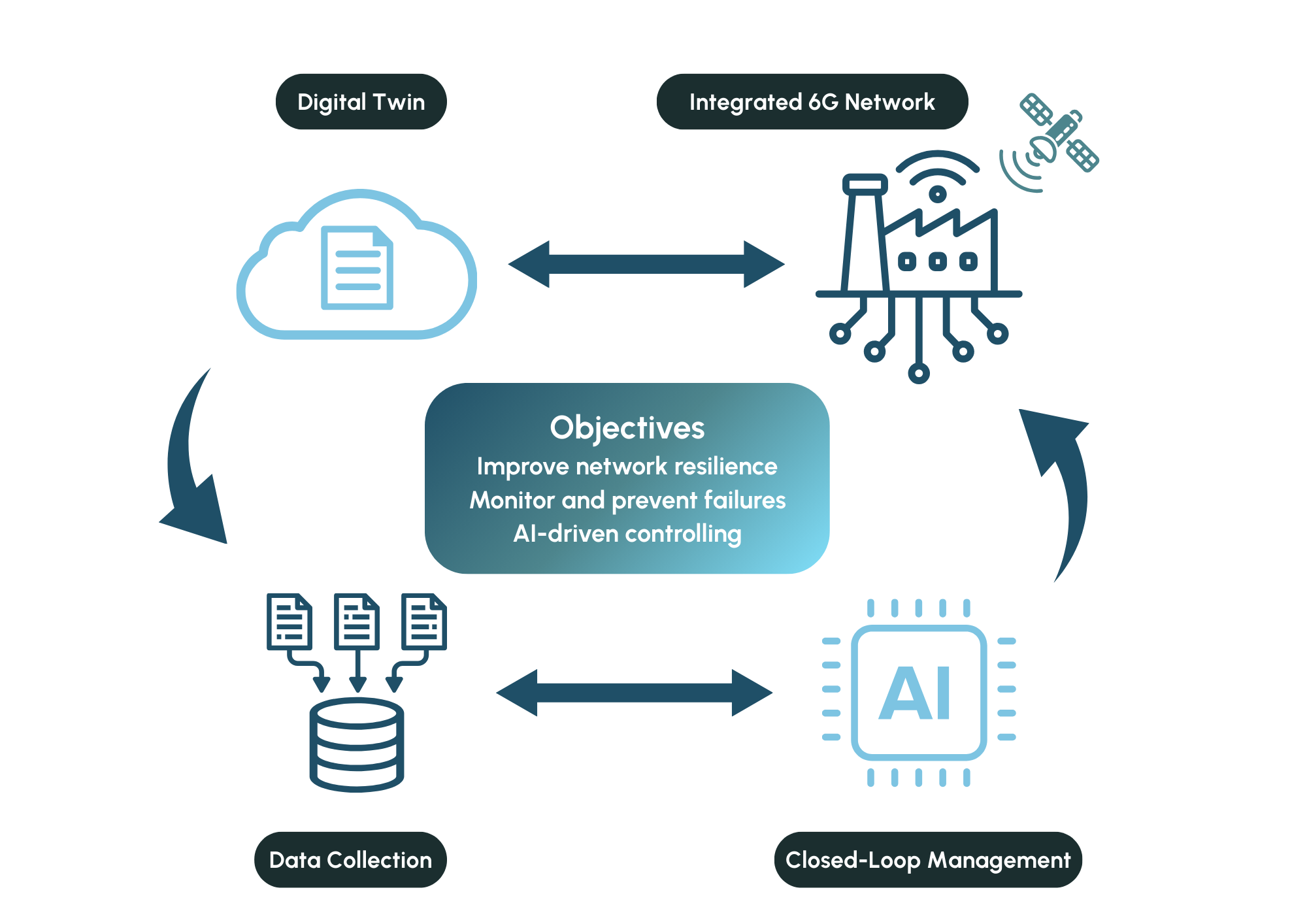
UNITY-6G’s “Digital twin for integrated 6G network evaluation” use case targets the core problem of operating a resilient, heterogeneous 6G infrastructure across terrestrial, transport, satellite, NPN, and edge-cloud domains. Instead of reacting to faults, the Digital Twin mirrors the end-to-end network—topology, functions, traffic, context, and policies—to enable proactive decision-making, predictive control, and AI-driven closed-loop management. Continuous telemetry from real infrastructure feeds the Digital Twin while simulated actions and AI models feed back as recommendations or automated reconfigurations, preventing equipment failures and minimizing service disruption.
Motivation
Building and running multi-domain 6G systems is complex: resources are scattered, failure modes are opaque, and configuration space explodes. The Digital Twin addresses this by aggregating real-time and historical data, generating statistics, and learning patterns to forecast issues. It shortens the “sense–decide–act” loop for operators, accelerates site rollout and configuration, and improves orchestration across radio, transport, satellite, and edge resources—raising overall robustness and trustworthiness.
Objectives
Novelties
The use case unifies heterogeneous domain knowledge into a living, AI-empowered replica that closes the loop between observation, prediction, and actuation. Beyond mere transparency, it delivers actionable intelligence: control knobs (e.g., scheduling, placement, parameter tuning) are exposed to real-time (dApps), near-real-time (xApps), and non-real-time (rApps) controllers. Historical replay, synthetic data generation, and preventive-maintenance insights become first-class capabilities. In short, this is not just a dashboard—it is an operational co-pilot for resilient 6G networks.
Outcome
A first-of-its-kind Digital Twin platform for integrated 6G networks that: