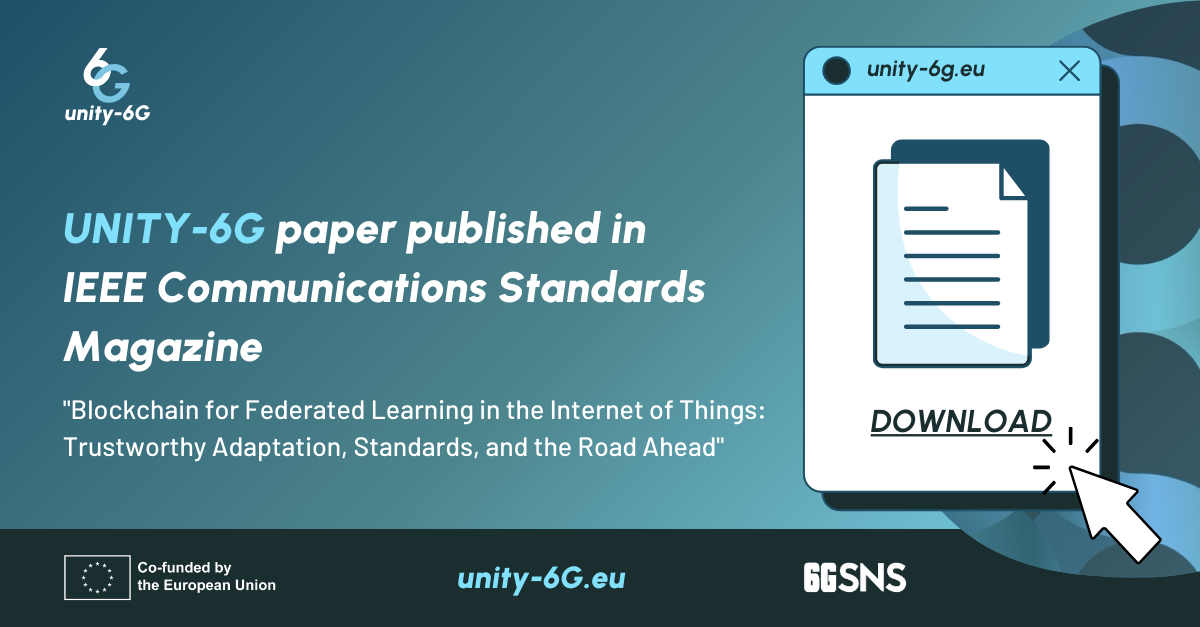
UNITY-6G partners from CTTC, Farhana Javed, Engin Zeydan, Luis Blanco, and Josep Mangues-Bafalluy published a new paper titled “Blockchain for Federated Learning in the Internet of Things: Trustworthy Adaptation, Standards, and the Road Ahead.” The paper, co-authored with Kapal Dev of Munster Technological University, Cork, Ireland, addresses the limitations of traditional federated learning (FL) in IoT ecosystems, specifically its reliance on centralized servers and lack of transparency. The authors propose integrating blockchain and other Distributed Ledger Technologies (DLTs) to create a more secure, decentralized, and trustworthy FL framework. The article summarizes current standardization efforts by organizations like 3GPP, ETSI, and IEEE, which are working to align FL and blockchain technologies for next-generation networks. The authors also present their own blockchain-based FL framework that replaces the centralized aggregator with a decentralized one, uses a reputation system to ensure data integrity, and minimizes overhead by selectively storing data on-chain. They also discuss the future of this synergy, emphasizing its potential for secure and efficient 6G networks and other industrial IoT applications.
Abstract—As edge computing gains prominence in Internet of Things (IoTs), smart cities, and autonomous systems, the demand for real-time machine intelligence with low latency and model reliability continues to grow. Federated Learning (FL) addresses these needs by enabling distributed model training without centralizing user data, yet it remains reliant on centralized servers and lacks built-in mechanisms for transparency and trust. Blockchain, a type of Distributed Ledger Technologies (DLTs) can fill this gap by introducing immutability, decentralized coordination, and verifiability into FL workflows. This article presents current standardization efforts from 3GPP, ETSI, ITU-T, IEEE, and O-RAN that steer the integration of FL and blockchain in IoT ecosystems. We then propose a blockchain-based FL framework that replaces the centralized aggregator, incorporates reputation monitoring of IoT devices, and minimizes overhead via selective on-chain storage of model updates. We validate our approach with IOTA Tangle, demonstrating stable throughput and block confirmations, even under increasing FL workloads. Finally, we discuss architectural considerations and future directions for embedding trustworthy and resource-efficient FL in emerging 6G networks and vertical IoT applications. Our results underscore the potential of DLT-enhanced FL to meet stringent trust and energy requirements of next-generation IoT deployments.
Read the full paper to learn more.