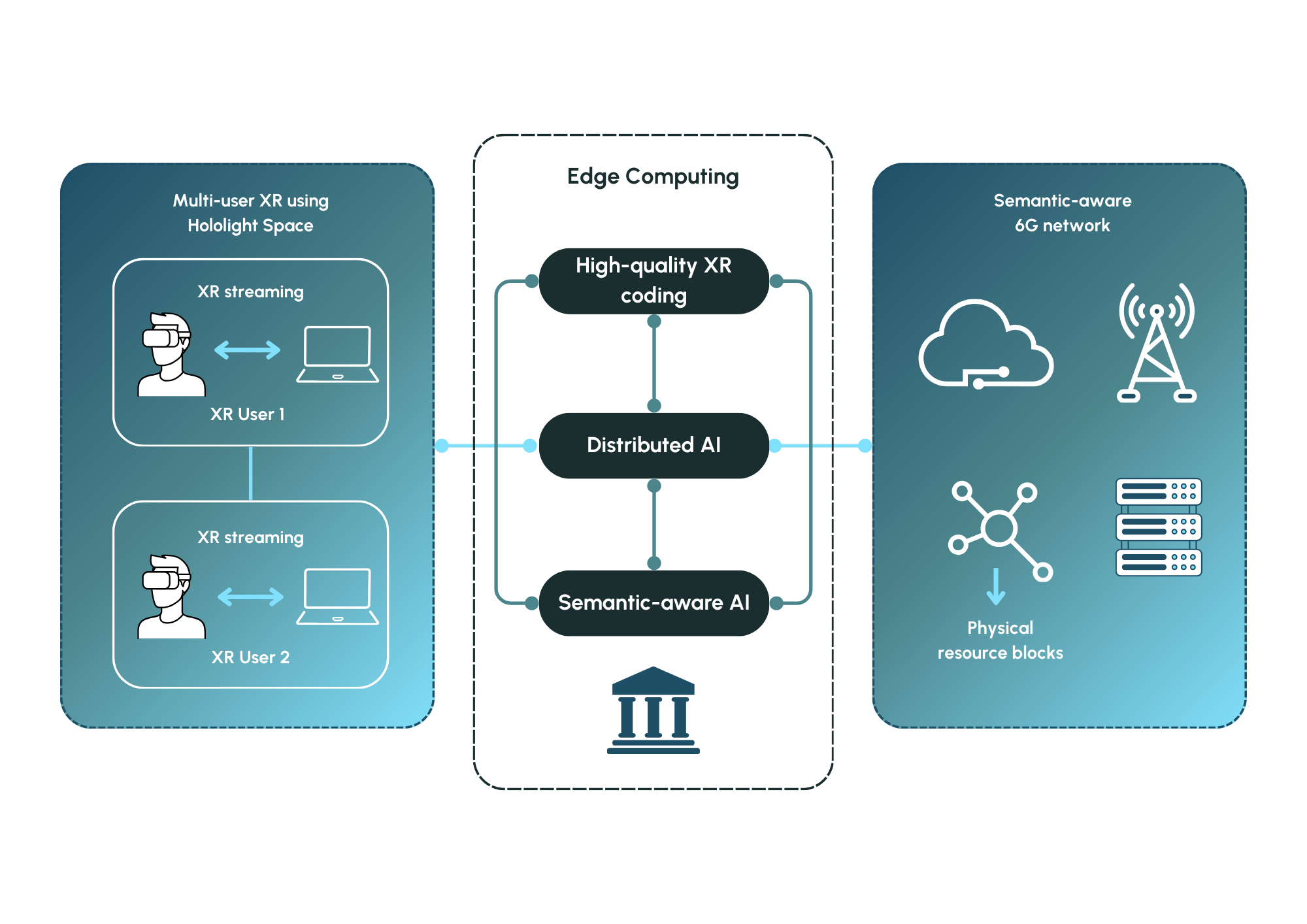
UNITY-6G’s “Immersive experience with real-time XR/holographic communication” use case is designed to enable seamless, real-time, multi-user XR collaboration using Hololight Space XR application in industrial environments, supported by a semantic-aware, intelligent 6G network. The system delivers high-quality holographic experiences with low latency, adaptive resource usage, and energy-efficient communication across distributed network layers.
The scenario involves participants at different locations within an industrial setting, collaborating within a shared 3D environment that includes high-fidelity holograms, real-time data overlays, and spatial annotations. This use case showcases Hololight Space, an XR application designed for engineering and industrial collaboration, deployed over a semantic-aware 6G network. The application enables a multi-user XR session, where remote participants can visualize and interact with complex 3D models or holographic content in real time. The application runs on a server located at the edge or in the cloud and streams content to XR devices using Hololight Stream—a pixel-streaming solution that offloads rendering from the device to the server, allowing lightweight XR glasses (e.g., HoloLens 2) to handle high-quality scenes with low latency.
The network is empowered by a semantic-aware 6G architecture, which intelligently adapts to the content’s meaning and urgency. Supporting this capability are edge computing and distributed AI components that continuously monitor application performance (via a Monitoring System), analyze real-time session metrics and user interactions (via an Analytics Engine), and dynamically allocate network and compute resources (via a Decision Engine). These resources include assigning CPU/GPU power, RAM, and physical radio blocks to ensure optimal stream quality, low latency, and reliability. Furthermore, the network leverages distributed ledger technologies (DLT) to ensure trust, transparency, and traceability of actions and data exchanges across stakeholders.
In real world, this system can transform how teams collaborate remotely, whether it’s engineers repairing critical infrastructure or emergency responders managing a disaster site. It reduces the need for travel, shortens decision cycles, and allows domain experts to guide field teams from remote locations with full spatial awareness. The energy-efficient and adaptive nature of the network also ensures that high-performance XR communication remains sustainable and scalable, even under fluctuating network loads or during deployments in mobile or temporary setups (e.g., over Ceragon wireless links in disaster zones). This combination of next-generation network intelligence, edge AI, and XR streaming lays the foundation for truly immersive, collaborative experiences over 6G.
The presented diagram encapsulates how the next-generation 6G infrastructure, powered by edge AI and semantic intelligence, can deliver a high-performance XR collaboration experience—whether it’s for remote industrial inspections, training simulations, or disaster site response.