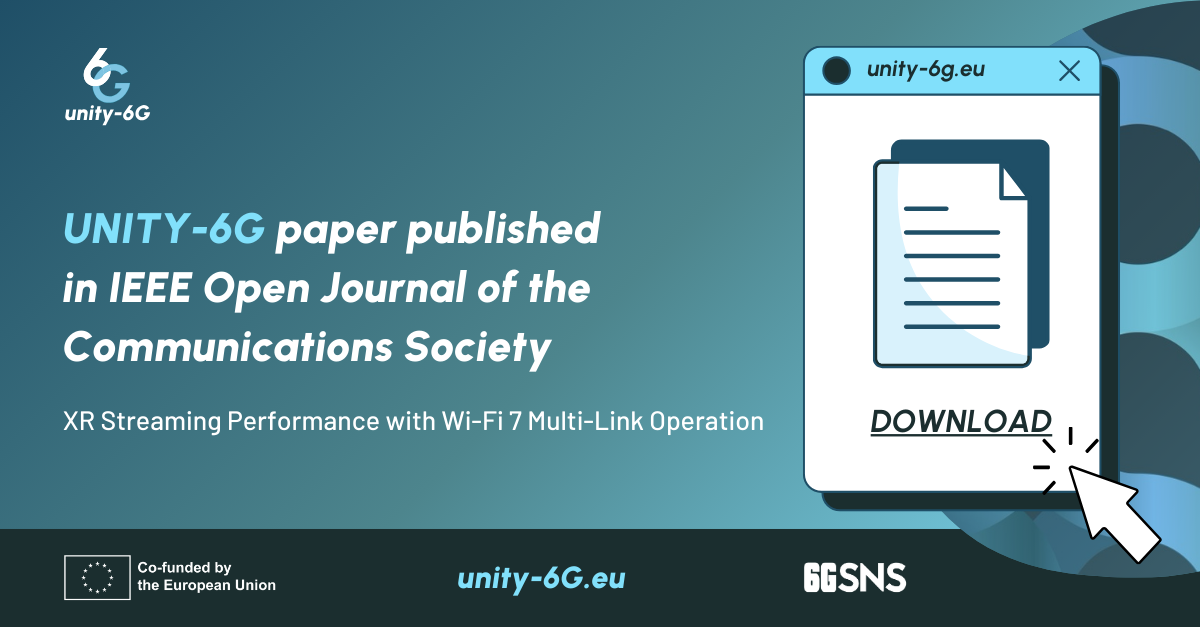
UNITY-6G partners coauthored a new paper titled “XR Streaming Performance with Wi-Fi 7 Multi-Link Operation.” The work by Marc Carrascosa-Zamacois, Lorenzo Galati-Giordano, Francesc Wilhelmi, Gianluca Fontanesi, Anders Jonsson, Giovanni Geraci, and Boris Bellalta investigates how Wi-Fi 7’s novel Multi-Link Operation (MLO) can meet the stringent throughput and latency requirements of Extended Reality (XR) applications. Using an MLO-compliant simulator with realistic VR traffic, the study demonstrates that MLO reduces delay—especially in the uplink—supports more users per access point than Single Link Operation (SLO), and provides greater robustness across diverse propagation conditions. Results further show that spreading bandwidth across more MLO links lowers delay, and that MLO-aware channel assignment strategies can mitigate interference in overlapping network scenarios. Overall, the findings highlight MLO’s potential to sustain demanding XR applications and significantly improve network scalability compared to SLO.
Abstract — Extended Reality (XR) has stringent throughput and delay requirements that are hard to meet with current wireless technologies. Missing these requirements can lead to worsened picture quality, perceived lag between user input and corresponding output, and even dizziness for the end user. In this paper, we study the capability of Wi-Fi 7, and its novel support for Multi-Link Operation (MLO), to cope with these tight requirements. Our study is based on simulation results extracted from an MLO-compliant simulator that realistically reproduces VR traffic. Results show that MLO can sustain VR applications. By jointly using multiple links with independent channel access procedures, MLO can reduce the overall delay, which is especially useful in the uplink, as it has more stringent requirements than the downlink, and is instrumental in delivering the expected performance. We show that using MLO can support more users per Access Point (AP) than an equivalent number of links using Single Link Operation (SLO). We also show that, while maintaining the same overall bandwidth, a higher number of MLO links with narrower channels leads to lower delays than a lower number of links with wider channels. We also study the impact of Overlapping Basic Service Sets (OBSS) on performance of XR applications, showing how SLO struggles to maintain a low delay when OBSS activity increases, and how MLO can cope with this interference by using MLO-aware channel assignment strategies. Finally, we consider random positioning for the users, showcasing that MLO can support 5× more users than SLO.
Keywords — Multi-Link Operation, XR streaming, IEEE 802.11be, Wi-Fi 7
Read the full paper to explore how Wi-Fi 7 Multi-Link Operation can revolutionize XR streaming performance and support more users with lower latency.