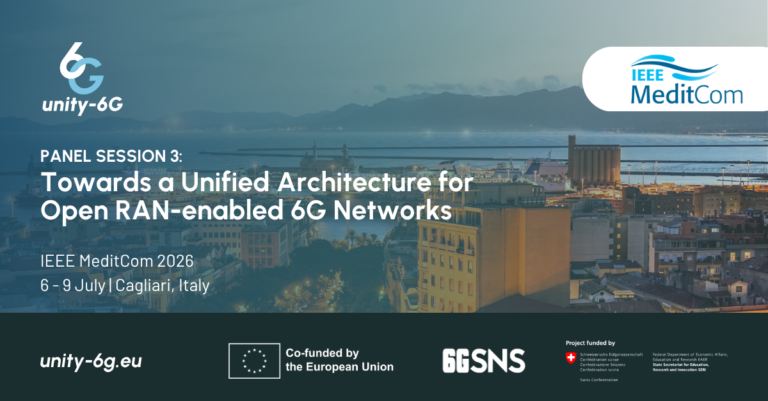
UNITY-6G partners Laura Finarelli and Gianluca Rizzo of HES-SO unveiled their recent research at the 23rd Mediterranean Communication and Computer Networking Conference (MedComNet 2025), held on June 25-27, 2025 in Cagliari, Italy. Their paper, “Assessing the Benefits of Ground Vehicles as Moving Urban Base Stations,” co-authored with Falko Dressler of TU-Berlin and Marco Ajmone Marsan of the IMDEA Networks Institute, presents a novel analytical framework for quantifying the potential advantages of the Moving Network (MN) paradigm within dynamic urban environments.
Abstract—In the evolution towards 6G user-centric networking, the moving network (MN) paradigm can play an important role. In a MN, some small cell base stations (BS) are installed on top of vehicles, and enable a more dynamic, flexible and sustainable, network operation. By “following” the users movements and adapting dynamically to their requests, the MN paradigm enables a more efficient utilization of network resources, mitigating the need for dense small cell BS deployments at the cost of an increase in resource utilization due to wireless backhauling. This aspect is at least partly compensated by the shorter distance between users and BS, which allows for lower power and Line-of-Sight communications. While the MN paradigm has been investigated for some time, to date, it is still unclear in which conditions the advantages of MN outweigh the additional resource costs. In this paper, we propose a stochastic geometry framework for the characterization of the potential benefits of the MN paradigm as part of an HetNet in urban settings. Our approach allows the estimation of user-perceived performance, accounting for wireless backhaul connectivity as well as base station resource scheduling. We formulate an optimization problem for determining the resource-optimal network configurations and BS scheduling which minimize the overall amount of deployed BSs in a QoS-aware manner, and the minimum vehicular flow between different urban districts required to support them, and we propose an efficient stochastic heuristic to solve it. Our numerical assessment suggests that the MN paradigm, coupled with appropriate dynamic network management strategies, significantly reduces the amount of deployed network infrastructure while guaranteeing the target QoS perceived by users.
Read the full paper to explore the results and learn about the planned follow up.
About MedComNet 2025
The 23rd Mediterranean Communication and Computer Networking Conference (MedComNet 2025) continued the rich legacy of the MedHocNet conference series, which began in Sardinia in 2002. Held annually in picturesque Mediterranean locations, MedComNet serves as a premier international forum for showcasing cutting-edge research in the expansive field of wired and wireless communication and computer networking. The conference welcomes contributions spanning all facets of networking research.