For decades, communication networks have evolved by adding new technologies, including Wi-Fi, cellular, satellites, edge computing and cloud infrastructures, each with its own architecture, management framework and operational model. While this approach has driven remarkable innovation, it has also introduced increasing complexity. As 6G moves closer to reality, researchers are asking a different question: can these technologies be designed as parts of a single, intelligent system rather than as interconnected but largely independent ecosystems?
This question formed the basis of a panel discussion at the IEEE International Mediterranean Conference on Communications and Networking (IEEE MeditCom 2026), held from 6–9 July in Cagliari, Italy, where UNITY-6G contributed its vision for the next generation of Open RAN-enabled communication networks.
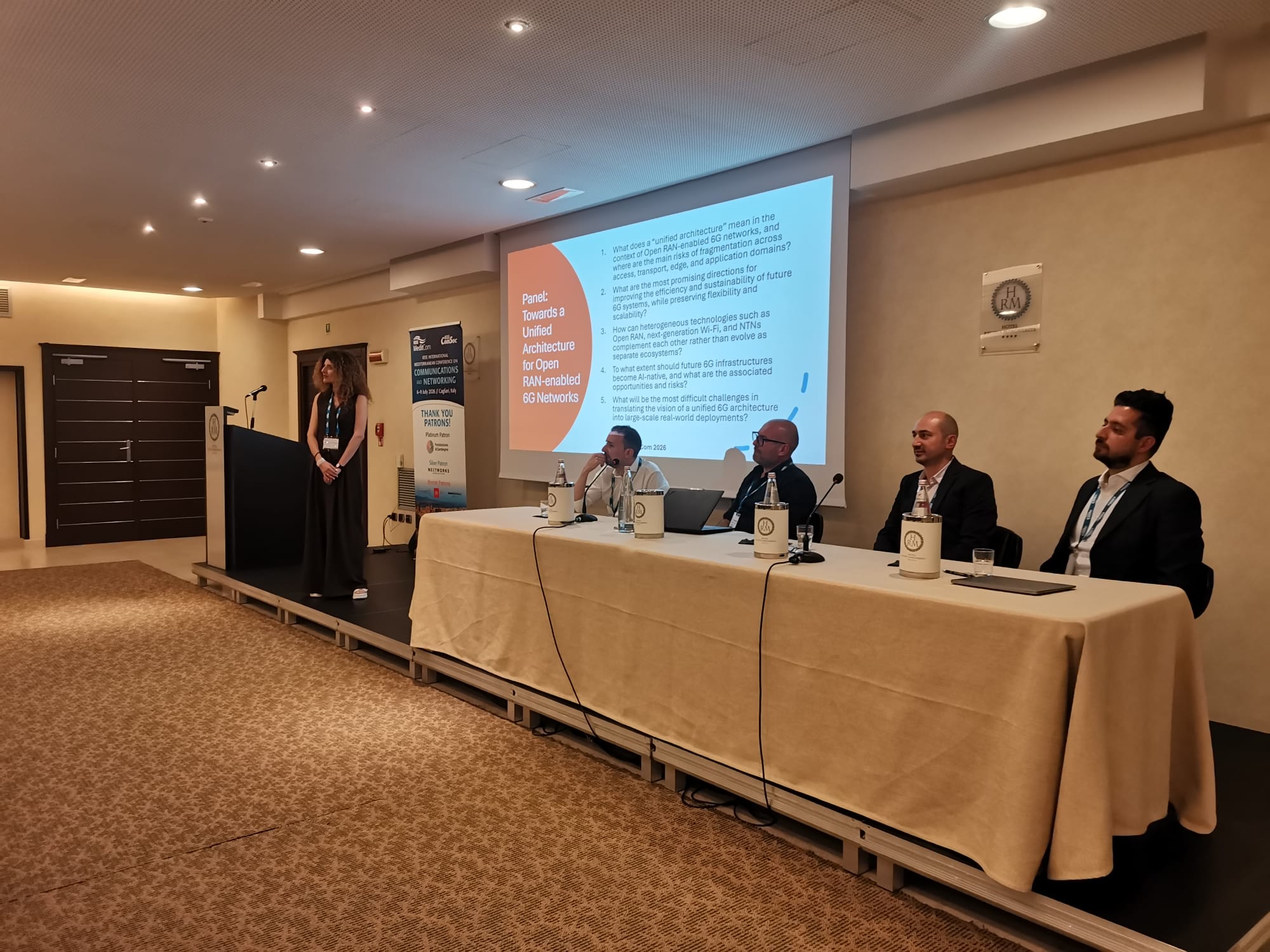
Organised within one of the IEEE Communications Society’s flagship conferences, the panel “Towards a Unified Architecture for Open RAN-enabled 6G Networks” brought together leading researchers from industry and academia to explore one of the defining architectural challenges of future mobile communications.
The panel addressed how emerging technologies, including Open RAN, next-generation Wi-Fi, edge computing, cloud-native infrastructures and Non-Terrestrial Networks (NTNs), can evolve into a coherent, AI-native architecture capable of supporting highly distributed, programmable and sustainable 6G systems.
Representing Nokia Bell Labs and the UNITY-6G consortium, Dr. Gianluca Fontanesi presented the project’s architectural vision and highlighted Nokia’s contributions to the development of a unified framework for future 6G networks [open presentation]. Building on UNITY-6G’s publicly available architectural work, he introduced the project’s main design pillars and discussed how the consortium is addressing key challenges including intelligent orchestration across heterogeneous domains, AI-native network management, energy-efficient operation, and the convergence of terrestrial and non-terrestrial communication infrastructures.
Rather than viewing Open RAN, Wi-Fi and satellite communications as competing solutions, the panel explored how these technologies can complement one another through common architectural principles. Such an approach could allow future networks to allocate computing and communication resources dynamically, optimise energy consumption in real time and support increasingly diverse applications ranging from immersive extended reality to autonomous systems and critical infrastructure.
The discussion also examined one of the fastest-moving trends in networking research: AI-native network operation. As future infrastructures become too complex to manage manually, artificial intelligence is expected to play an increasingly important role in orchestrating network functions, predicting traffic patterns, allocating radio resources and adapting services across cloud, edge and radio domains. At the same time, the panellists emphasised that these capabilities must be introduced responsibly, balancing automation with trustworthiness, scalability and operational resilience.
The panel was moderated by Dr. Marica Amadeo, Tenure Track Assistant Professor at the University of Messina, whose research focuses on information-centric networking, edge computing and distributed network architectures. She guided a lively discussion around several fundamental questions facing the communications community: What does a truly unified 6G architecture look like? How can heterogeneous access technologies work together rather than evolve as fragmented ecosystems? And how can future networks become both more intelligent and more sustainable?
Joining Gianluca Fontanesi on the panel were distinguished researchers representing different areas of next-generation networking research:
- Dr. Pasquale Imputato (University of Napoli Federico II), whose work focuses on Wi-Fi networks, low-latency communication and transport protocols;
- Dr. Amir Ashtari Gargari (CTTC), an expert in AI-driven optimisation, open-source network simulation and mmWave/6G systems;
- Dr. Carlos M. Lentisco (Universidad Politécnica de Madrid), whose research explores Multi-access Edge Computing, Network Slicing and the integration of terrestrial and non-terrestrial networks.
Together, the panel highlighted that achieving a unified 6G architecture is not simply a question of integrating new radio technologies. It requires rethinking how communication, computation and data are jointly orchestrated across increasingly distributed infrastructures, while ensuring interoperability, programmability, energy efficiency and long-term sustainability.
These themes lie at the heart of the UNITY-6G project. By developing an AI-native, service-oriented architecture capable of spanning cloud, edge, terrestrial and satellite environments, the project is helping establish the foundations for communication systems that are not only more capable, but also more flexible, open and resilient.