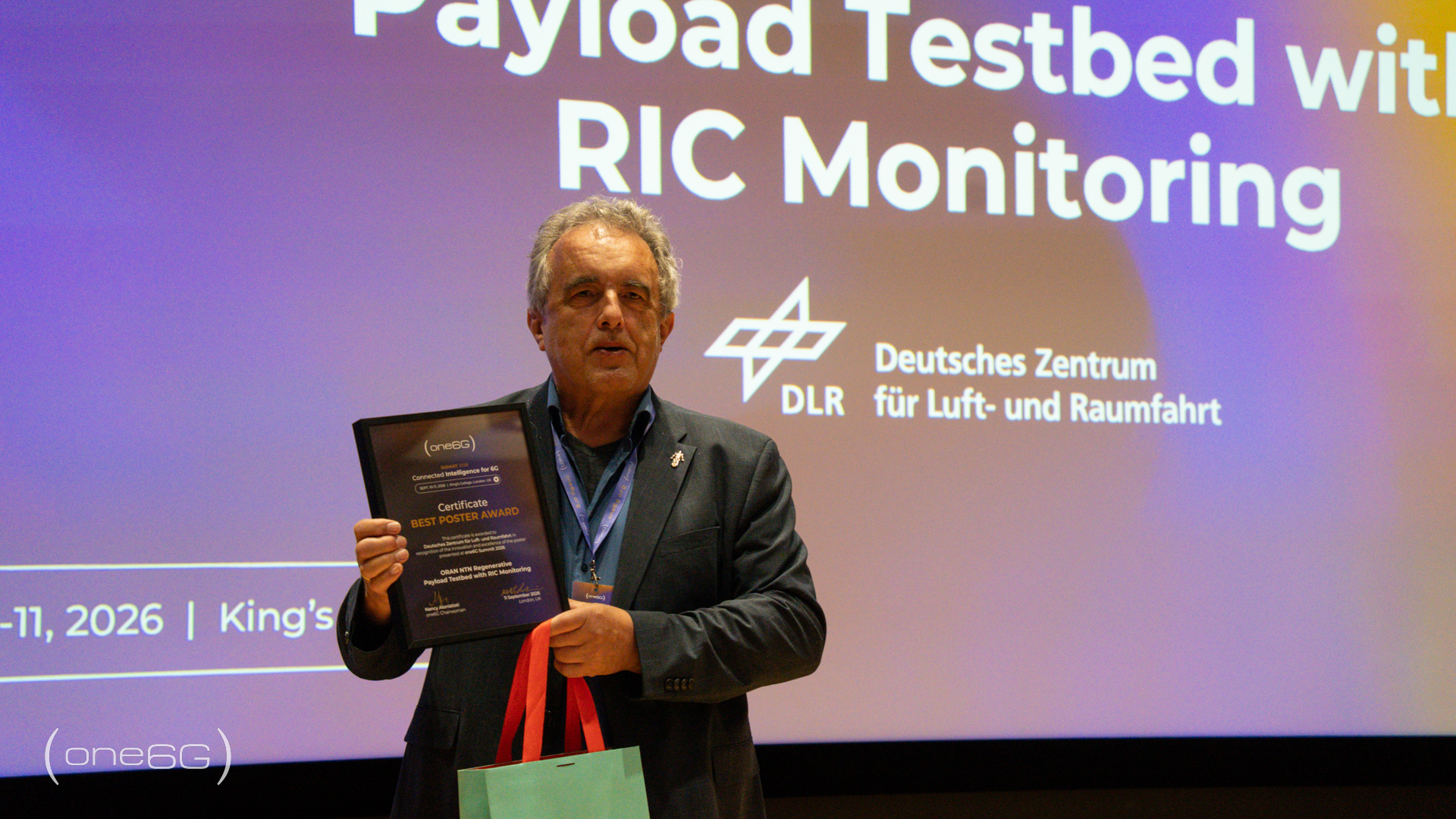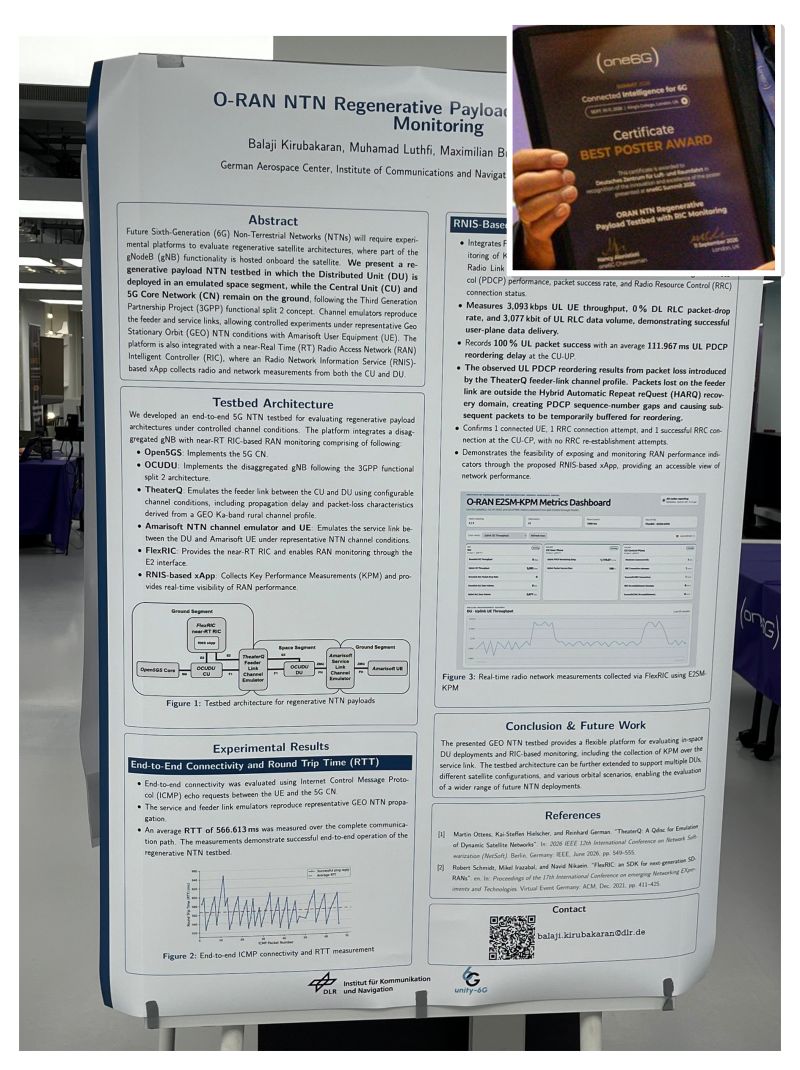
The German Aerospace Center (DLR), a partner in the UNITY-6G project, has received the Best Poster Award at the one6G Summit 2026 for its research on regenerative satellite payloads and intelligent radio network monitoring.
The award was presented at the one6G Summit 2026, held on 10–11 September at King’s College London, UK. Bringing together researchers, industry representatives and innovators from across the global 6G ecosystem, the event featured technical presentations, live demonstrations and an interactive poster session exploring emerging developments in next-generation communications.
DLR received the Best Poster Award for its contribution, “O-RAN NTN Regenerative Payload Testbed with RIC Monitoring”, recognising research that addresses a key challenge for future 6G networks: integrating satellite communications into open, programmable and intelligent network architectures.
Bringing intelligent network control into satellite communications
As 6G networks evolve, satellites are expected to play an increasingly important role in extending connectivity beyond the reach of terrestrial infrastructure and supporting more resilient communications.
However, integrating satellite and terrestrial networks requires more than establishing a communication link. Satellite systems must also support flexible network functions, efficient resource management and interoperability with emerging 6G architectures.
DLR’s award-winning poster presents a regenerative payload testbed that brings Open Radio Access Network (O-RAN) capabilities into a Non-Terrestrial Network (NTN) environment.
Unlike conventional transparent satellite payloads, which primarily relay signals between the ground and users, regenerative payloads can process communication signals on board the satellite. This creates opportunities to distribute network functions between space and ground infrastructure.
The presented testbed explores this approach through an architecture in which the distributed unit (DU) is deployed in an emulated space segment, while the central unit (CU) and 5G Core Network remain on the ground.
The system also incorporates a near-real-time RAN Intelligent Controller (Near-RT RIC), enabling the collection and monitoring of radio network performance data through an O-RAN-compatible interface.
This provides a platform for investigating how intelligent radio network management could be extended to future satellite-based 6G systems.
From architectural concepts to experimental validation
The poster presents experimental results demonstrating end-to-end connectivity through the regenerative NTN testbed, alongside the collection of radio network performance measurements.
The architecture combines an open-source 5G Core Network, a disaggregated gNB implementation, satellite-channel emulation and RIC-based monitoring capabilities.
By bringing these components together, the testbed enables researchers to examine the behaviour of satellite communication systems under different network and channel conditions.
It also establishes a foundation for future work on intelligent radio resource management and the evaluation of different satellite configurations and orbital scenarios.
For UNITY-6G, this research contributes to the project’s wider ambition of developing a unified, open and AI-native architecture capable of integrating terrestrial and non-terrestrial networks.
Recognising the researchers behind the achievement
The award-winning contribution was developed by researchers at the DLR Institute of Communications and Navigation, including Balaji Kirubakaran, Muhamad Luthfi and Maximilian Burr.
DLR also acknowledged the guidance and support of Tomaso de Cola, as well as the efforts of the one6G Summit organisers, committee members and volunteers in bringing together the international research community.
The Best Poster Award was announced during the summit’s closing ceremony, following an interactive poster session in which attendees were invited to vote for the most impactful contributions.
The recognition highlights the relevance of DLR’s work to the development of open and intelligent satellite communication systems and the broader research effort towards integrated 6G networks.
Congratulations to our colleagues at DLR on this achievement!
Read more about the award and the other recognised contributions in the official one6G announcement: Best Demo and Poster Awards winners revealed at one6G Summit 2026 in London .