On January 22, 2026, the one6G Open Lecture 11 brought together industry experts to discuss the integration of Non-Terrestrial Networks (NTN) into the 6G framework. Titled “Non-Terrestrial Networks for 6G: Toward Seamless Network Convergence,” the session focused on how satellites, high-altitude platforms (HAPs), and UAVs will function alongside traditional ground networks.
The event was moderated by Malte Schellmann, Principal Research Engineer and Technology Manager at the Huawei Munich Research Center, who opened the session by highlighting the role of NTNs in delivering resilient, borderless connectivity. The lecture featured four leading researchers in the field, who talked about the shift toward a truly integrated 6G infrastructure:
- Alessandro Vanelli-Coralli (Professor at the University of Bologna and ETH Zürich; UNITY-6G partner) who opened the technical sessions with a talk about Integrated TN/NTN Architectures in 6G: Opportunities and Challenges. He outlined architectural visions and the key technical hurdles required to achieve full network convergence.
- Symeon Chatzinotas (Professor at the University of Luxembourg) who presented Sustainable NTNs through AI, ISAC and RIS.
- Tomaso de Cola (Leader of the Integrated Satellite Systems Group at DLR; UNITY-6G partner) who presented From Ground to Space and Back: the Next Frontier of Edge-Cloud Continuum.
- Miguel Ángel Vázquez Oliver (Head of the Space and Resilient Communications and Systems Research Unit at CTTC) who shared insights on Practical 6G-NTN: Hypes, Constraints, and Design Options.
UNITY-6G partners’ presentations
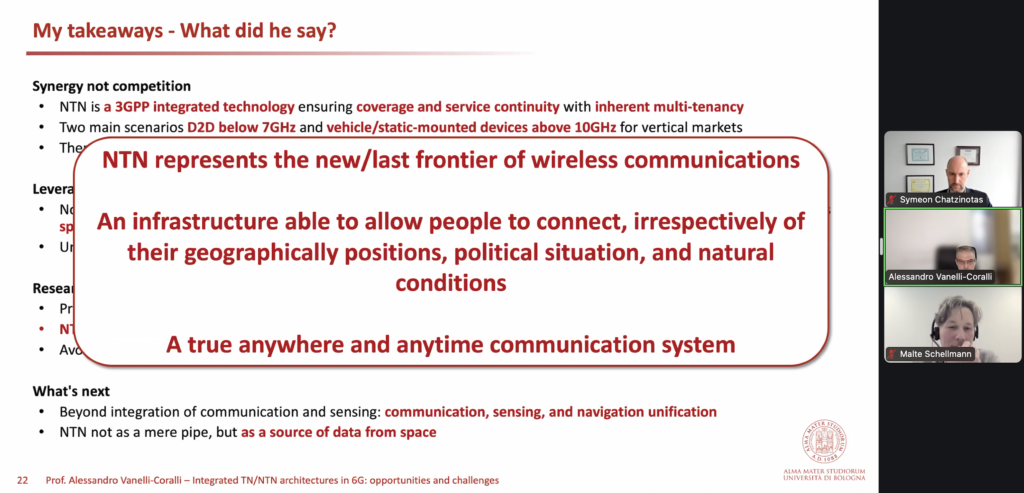
Alessandro Vanelli-Coralli discussed Integrated TN/NTN Architectures in 6G: Opportunities and Challenges. His talk outlined the fundamental architectural shifts required to move from isolated networks to a fully converged system.
Key points from his presentation included:
- Integrated Design: Transitioning from “add-on” satellite components to a native, unified 6G architecture.
- Technical Hurdles: Identifying the critical gaps in synchronization, mobility management, and spectrum sharing.
- Full Convergence: The roadmap toward a network where the transition between terrestrial and non-terrestrial layers is invisible to the end user.
Tomaso de Cola explored the integration of satellite systems into the edge–cloud continuum. His talk, From Ground to Space and Back, emphasized that satellites should be viewed as active nodes in a distributed computing ecosystem rather than simple “bit pipes.”
Key points from his presentation included:
- Distributed Computing: The concept of managing and orchestrating resources across both ground and space-borne assets.
- Low-Latency Services: How NTNs can enable edge computing services in remote or underserved regions.
- Practical Convergence: Navigating the technical complexities of implementing distributed intelligence across terrestrial and space domains.
Perspectives on NTN Integration
The event concluded with a Q&A where a number of participants raised technical and regulatory questions regarding the complexity of seamless TN–NTN integration. With nearly 270 attendees from across the world, the lecture highlighted the industry’s focus on NTN as a specific, yet vital, component of the future 6G landscape. The session was recorded and can be viewed on one6G’s YouTube channel (here).