From AI-native orchestration and Network Digital Twins to Open RAN innovation and agentic AI, the UNITY-6G consortium showcased a broad range of technologies shaping the future of 6G at the EuCNC & 6G Summit 2026 in Málaga, Spain.
Throughout the week, project partners contributed scientific papers, workshop presentations and live demonstrations, engaging with researchers, industry stakeholders and standards experts on one of the key questions facing future communication systems: how can increasingly complex networks become more intelligent, autonomous and sustainable?
Building the Foundations of AI-Native 6G
The conversation began with the architectural challenges facing next-generation networks.
In the AI4C8 session, Engin Zeydan (CTTC) presented “Empowering Next-Generation AI Through Cognitive Cloud-Edge-IoT Continuum: Architecture, Management, and Challenges”, examining how distributed AI workloads can be orchestrated across cloud, edge, IoT and high-performance computing environments. As AI becomes deeply embedded in network operations, the work highlights the need for new approaches that can balance performance, trust, scalability and energy efficiency across highly distributed infrastructures.
Earlier in the conference, Luis Blanco (CTTC) introduced UNITY-6G’s broader vision through the paper “Advances on Unified Architecture for Open-RAN Enabled Distributed and Scalable 6G Networks”. The presentation outlined a unified framework capable of bringing together terrestrial, non-terrestrial and non-public networks under a common architecture, combining Open RAN principles, AI-native management, Digital Twins, semantic communications and autonomous decision-making mechanisms.
Together, the two contributions reflected a growing shift in the research community: future networks will not simply transport data—they will increasingly coordinate computing resources, intelligence and services across multiple domains.
From Network Digital Twins to Intelligent Automation
This theme continued throughout the conference workshops.
At the workshop on Network Digital Twins for AI-driven 6G systems, Paweł Kryszkiewicz (Poznan University of Technology) presented UNITY-6G’s work on Digital Twins for heterogeneous 6G environments. His presentation explored how digital replicas of network infrastructures can provide operators with new tools for modelling, testing and optimising increasingly complex multi-domain systems before changes are deployed into live networks.
Meanwhile, at the workshop on AI-native networking, Giacomo Bernini (Nextworks) discussed the challenge of managing distributed AI and machine learning workloads through AI/MLOps frameworks. The presentation highlighted how future networks will require not only intelligent applications but also mechanisms for training, validating and continuously operating AI across cloud-edge infrastructures.
The discussion then moved from orchestration to trust. Harilaos Koumaras (NCSR Demokritos) explored how AI can be applied to security monitoring, intrusion detection and anomaly management while maintaining explainability, robustness and responsible deployment practices. Complementing this perspective, Maria Serrano (Nearby Computing) presented work on AI-driven service orchestration, demonstrating how advanced AI techniques can help manage increasingly dynamic services and user requirements across distributed environments.
Demonstrating the 6G Building Blocks
While the conference sessions explored future concepts, the UNITY-6G exhibition booth offered visitors the opportunity to see several of these ideas in action.
One of the featured demonstrations, presented by imec IDLab (UGent-imec), challenged a long-standing assumption in Open RAN. Rather than focusing exclusively on cellular infrastructure, the demonstration showed how IEEE 802.11 access points can be integrated into an O-RAN ecosystem, extending programmability, observability and intelligent control to Wi-Fi environments. The work illustrates how future 6G networks may manage multiple radio technologies through a common orchestration framework.
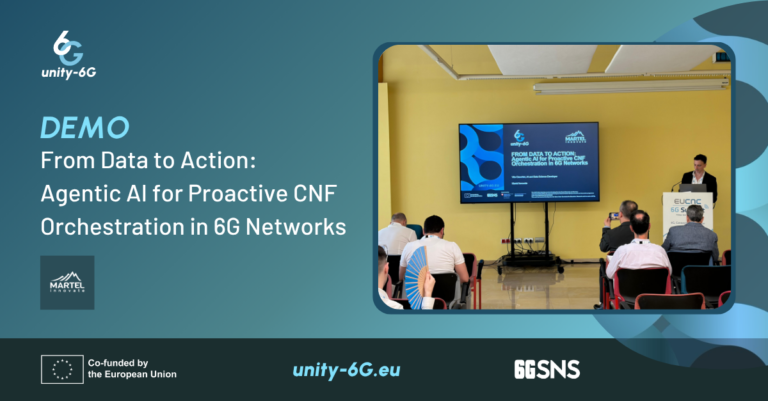
Another popular demonstration came from Vito Cianchini (Martel Innovate), who showcased “Agentic AI for Proactive Workload Orchestration.” Instead of relying on predefined automation rules, the system continuously analyses network conditions, evaluates alternative actions and proactively adapts workload placement across distributed cloud-native infrastructures. The demonstration offered a glimpse into how future networks may evolve from automated systems towards infrastructures capable of reasoning and acting autonomously.
Throughout the event, the booth became a meeting point for discussions on Open RAN, non-terrestrial networking, AI-native architectures, orchestration and the practical challenges of building unified 6G infrastructures.
Recognition for Research and Standardisation Contributions
EuCNC & 6G Summit 2026 also brought special recognition for the UNITY-6G consortium. During the conference gala dinner, Javier Velázquez Martínez (Telefónica Innovación Digital), leader of UNITY-6G Work Package 2, received the ETSI Research & Innovation Award 2026 in the Young Researcher category.
The award recognises his contributions to the development of the Network Slice Controller (NSC) within the ETSI TeraFlowSDN ecosystem, including the integration of 3GPP and IETF network slicing models and energy-aware slice orchestration. The achievement highlights the project’s strong contribution to both open-source innovation and the standardisation of future 6G networks.
Advancing the Road Towards Unified 6G
Beyond the individual presentations and demonstrations, UNITY-6G’s participation at EuCNC & 6G Summit 2026 highlighted the project’s broader ambition: bringing together connectivity, computing and intelligence within a unified architectural framework.
Whether through Digital Twins, AI-native orchestration, Open RAN innovation or agentic automation, the consortium’s contributions addressed different aspects of the same challenge—how to build future networks that remain open, scalable, trustworthy and sustainable while operating across increasingly heterogeneous environments.
As research and development moves closer to practical deployment, these technologies are expected to play a central role in enabling the next generation of intelligent 6G systems.