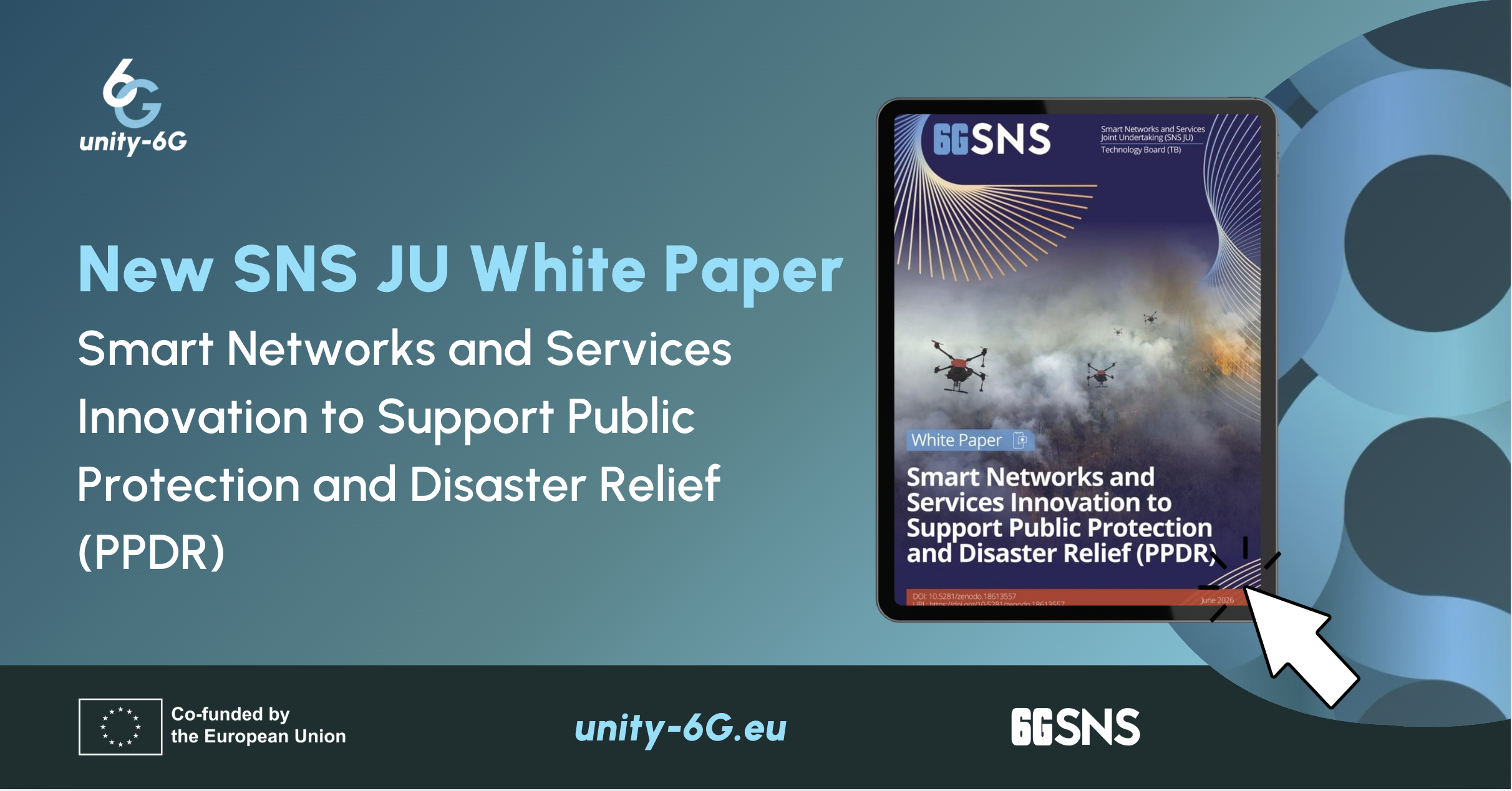
The Smart Networks and Services Joint Undertaking (SNS JU) Technical Board has released a comprehensive new white paper, “Public Protection and Disaster Relief,” mapping how next-generation communication networks will fundamentally transform mission-critical services and emergency response scenarios in the 2030s and beyond.
The strategic document features expert contributions from across the European 6G ecosystem, including UNITY-6G project partner Tomaso de Cola from the German Aerospace Center (DLR). The paper outlines how 6G will move beyond a simple performance upgrade to serve as a vital foundation for European societal resilience, built preparedness, and cross-border interoperability.
A Vision for Next-Generation Emergency Response
The white paper details a 2040 vision where European first responders arriving at any crisis scene can immediately connect to a shared, real-time operational picture across multiple agencies and assets. To realize this, the paper identifies four critical technology domains that align closely with the ongoing research priorities of the UNITY-6G consortium:
- Hybrid Terrestrial and Non-Terrestrial Networks (NTN): Providing essential connectivity redundancy to ensure communications remain functional even when ground-based infrastructure is destroyed.
- Edge and Cloud-Native Infrastructure: Pushing real-time, compute-intensive intelligence directly to the frontlines where split-second decisions are made.
- AI and Machine Learning: Enabling closed-loop network self-optimization to alleviate heavy cognitive loads on emergency operators during complex incidents.
- Integrated Sensing and Communication (ISAC): Turning the network itself into a native sensing environment capable of tracking personnel and monitoring hazards where traditional sensors fail.
Driving European Resilient Infrastructure
The release of this white paper serves as a key roadmap for bridging the gap between experimental testbed performance and the operationally validated, trusted capabilities that European emergency agencies and citizens can depend on when central infrastructure fails.
Through its active involvement in these strategic publications, UNITY-6G continues to help chart the course for next-generation digital safety systems and secure communication frameworks across Europe.